Hair growth after a transplant: the stages.
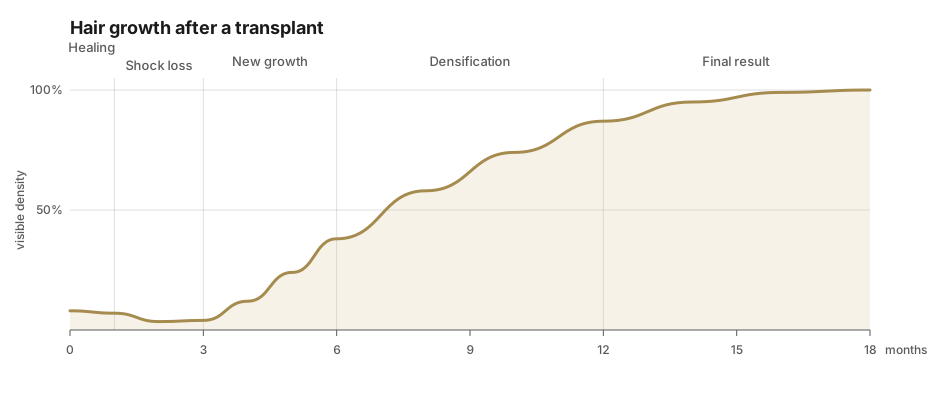
Between the procedure and the final result lie 12 to 18 months, and the journey is anything but linear. Knowing the stages means you can watch shock loss happen without worrying, and you know exactly when patience pays off. Here is the timeline, month by month.
Last updated: September 2026
- Shock loss
- weeks 2 to 8, normal
- First regrowth
- from month 3 to 4
- Visible density
- months 6 to 9
- Final result
- months 12 to 18
- Growth rate
- about 1 cm per month
- Progress tracking
- standardised photos
The natural hair cycle
Every hair moves through three phases: the growth phase (anagen, 2 to 6 years, around 85 to 90 percent of all hairs), a short transition (catagen) and the resting phase (telogen, 2 to 4 months), at the end of which the hair sheds and the follicle restarts. Transplanted follicles keep this behaviour: they come from the permanently growing donor ring at the back of the head and simply resume the same cycle after being moved. That is exactly why new growth starts with a delay.
Months 0 to 1: healing in
During the first 10 to 14 days the grafts anchor in the tissue, the crusts clear and the redness slowly fades. What matters now is covered in the aftercare guide: the right sleeping position, gentle washing, no sport and no sun. By the end of the first month the result often already looks surprisingly dense; that impression is temporary.
Months 1 to 3: shock loss
Between weeks 2 and 8, most of the transplanted hairs fall out. It sounds alarming, but it is the expected course: relocation pushes the follicle into its resting phase, the hair shaft is released, and the follicle itself stays safely anchored. Some fine existing hair around the area can shed temporarily too. During this stage the recipient area can look close to where you started; that is part of the process and not a preview of your result.
Months 3 to 6: new growth
From month 3 to 4 the first new hairs break through the scalp, initially fine, light and uneven, sometimes slightly curly. Both normalise as the hairs gain thickness. Small pimples at individual exit points are harmless at this stage and clear on their own. Towards the end of month six, the new hairline is clearly visible in the mirror.
Months 6 to 12: densification
Now comes the part you have been waiting for: the hairs become thicker, darker and more even, and density increases month by month. Around month 9, typically 70 to 80 percent of the expected result is visible. Hairstyles become plannable again and the transplanted area blends into the existing hair.
Months 12 to 18: the final result
At 12 months the hairline and front are largely final; the crown catches up between months 14 and 18 because of its weaker blood supply. Only now is it time for the definitive assessment, together with your treatment team and against the standardised photos taken from day one.
How to support every stage
The tempo of the cycle cannot honestly be shortened, but the conditions can be optimised: PRP treatments from around week 4 and peptide protocols during the growth phase support circulation and follicle nutrition. Add the unspectacular but effective basics: iron, vitamin D and zinc in the healthy range, enough sleep, no smoking. As part of the Longevity Rooms ecosystem, this holistic view is built into our free hair analysis.
Legal note: this page does not replace medical advice. Individual suitability, risks and prospects of success are clarified exclusively in a personal consultation.
Frequently asked questions
Is shock loss after a hair transplant normal?
Why does the crown grow more slowly?
Can I speed up hair growth after a transplant?
When can I judge the final result?
Ready for the first step? Your analysis is free.
Four questions, two minutes, and you know what is possible. No obligation, discreet, no sales pressure.